
Quartzite floors are valued for their natural patterns, durability, and distinctive appearance. However, restoring or polishing quartzite requires an understanding of the stone's hardness and mineral composition. As a hard natural stone, quartzite can be more challenging to grind and polish than softer materials such as marble. The process needs suitable diamond abrasives, appropriate machine settings, and a carefully controlled polishing sequence. Whether the goal is to restore a worn floor or improve the appearance of a newly installed surface, the first step is to assess the stone's condition and determine the level of refinement required.
Before polishing begins, inspect the floor for scratches, uneven joints, surface wear, cracks, and damaged areas. Identify any existing coatings, sealers, or residues that may interfere with the polishing process. Loose tiles and damaged joints should be addressed before mechanical work starts. It is also important to confirm that the material is genuine natural quartzite rather than engineered quartz or another stone with a similar appearance, since their composition and processing requirements can differ. Test a small, inconspicuous area first to evaluate how the stone responds to the selected abrasives and polishing method.
Surface preparation has a significant effect on the final result. If the floor has deep scratches, lippage, or noticeable unevenness, an initial grinding stage may be necessary before finer polishing begins. Select the starting diamond grit according to the amount of material that needs to be removed. Using an unnecessarily coarse abrasive can create deeper scratches and increase the time needed for subsequent refinement. During grinding, maintain consistent machine movement and avoid excessive pressure, which can lead to uneven wear or surface marks. For less damaged floors, a less aggressive starting grit may be sufficient.
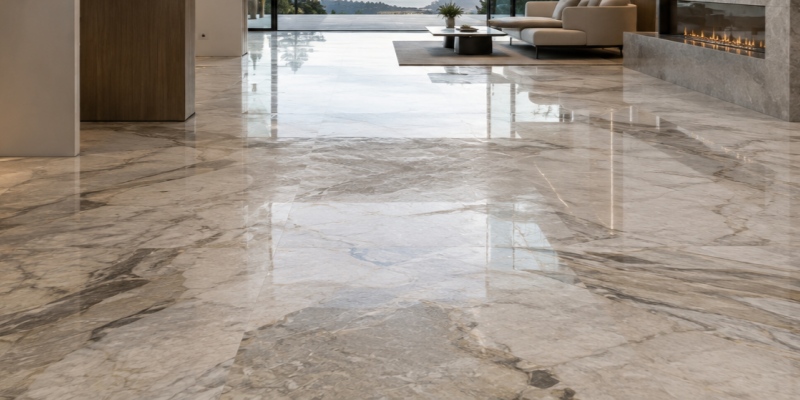
Once the surface has been properly prepared, move through progressively finer diamond abrasives to refine the scratch pattern and develop the desired finish. Each stage needs to remove or sufficiently refine the marks left by the previous one before moving to the next grit. Wet polishing is commonly used for natural stone because water helps cool the working area and carry away abrasive residue. Keep the floor and tooling clean between grit changes to prevent coarse particles from creating unwanted scratches. The final level of polishing depends on the stone itself, the condition of the floor, and the desired appearance; a high-gloss finish should not be assumed to be the right choice for every installation.
Tool selection and access to different floor areas also influence the polishing process. A Velcro backing diamond polishing pad can be used with a compatible backing plate, making it convenient to change between grit stages. For corners, narrow sections, and other areas that are difficult to reach with a conventional round pad, a triangle polishing pad may be useful when the machine and pad system are designed for that application. Honeycomb dry polishing pads can also be considered for suitable dry-polishing applications, provided the pad manufacturer's recommendations, machine compatibility, and the stone's heat sensitivity are taken into account. Not every pad is suitable for every quartzite floor, so always check the recommended operating conditions and test the tooling before treating a larger area.
After polishing, remove any remaining slurry, abrasive residue, and dirt using cleaning products suitable for the specific stone. Allow the floor to dry and inspect the finish under consistent lighting to check for uneven gloss, remaining scratches, or visible marks. If a penetrating sealer is appropriate for the particular quartzite, apply it according to the manufacturer's instructions; sealing is a separate treatment and does not replace proper polishing. For ongoing maintenance, use a pH-neutral cleaner recommended for natural stone and remove grit regularly to reduce surface abrasion from foot traffic. With careful preparation, a suitable diamond polishing sequence, and consistent maintenance, quartzite floors can retain their natural character and polished appearance for years.

 IPv6 rete supportata
 English
 français
 Deutsch
 русский
 italiano
 español
 português
 العربية
 日本語
 Polski
 中文